
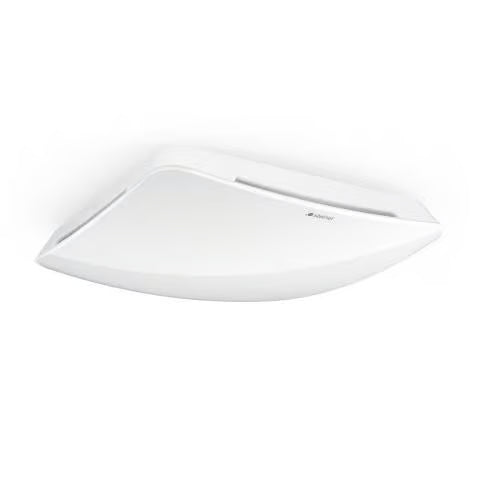
The principle
A constant light control sensor measures the actual illuminance at the working plane (usually via a light sensor built into the presence/light sensor housing) and continuously adjusts the dimming level of the luminaire to maintain a set lux target — regardless of how much daylight is contributing. As daylight increases, the sensor dims the artificial light down; as daylight fades, it brings the artificial light back up to hold the target.
This is different from simple daylight harvesting on a timer or step-dim schedule. Constant light control is a closed feedback loop: sensor reads lux → compares to setpoint → adjusts output → re-measures.
Why commissioning is the part that matters
The sensor doesn't measure the illuminance on the desk — it measures illuminance at the sensor, which is typically ceiling-mounted. The relationship between "lux at the sensor" and "lux at the working plane" has to be calibrated during commissioning, usually by:
- Setting artificial light to 100%, with no daylight contribution (blinds closed or after dark)
- Measuring actual lux at the working plane with a handheld meter
- Recording the corresponding sensor reading
- Setting that sensor reading as the calibration reference point, so the control loop's internal target maps correctly to a real-world lux level
Skip this step and the system will hold whatever lux level happens to correspond to the sensor's factory default — which may be nowhere near the design illuminance for the space.
Common failure points
- Sensor mounted too close to a luminaire it isn't controlling, picking up contribution from neighbouring fittings and never allowing full output
- No cut-off or deadband set, causing hunting — the loop continuously overshoots and corrects in small oscillations, visible as light "breathing"
- Ignoring reflectance changes — a room repainted a darker colour or re-carpeted changes the sensor's baseline reading without any change to actual working-plane lux
Constant light control is one of the more genuinely energy-effective features in a lighting control system — perimeter zones near windows can run at a fraction of nominal output for most of the day — but only when it's calibrated, not just switched on.
Share:
PIR, Microwave or Dual-Technology: Choosing the Right Detection Method for Presence Sensors
DALI-2 vs DALI-1: What "Compatible" Actually Means for Integrators