
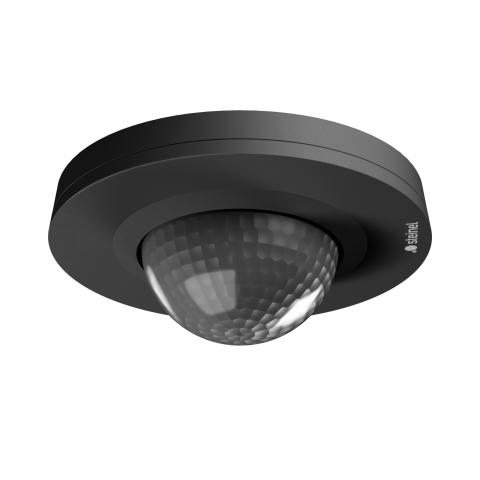
Most sensor selection mistakes aren't about brand — they're about detection technology mismatched to the space. Get this wrong and you end up with lights that switch off mid-meeting, or a car park sensor that never sees a stationary vehicle.
Passive infrared (PIR)
PIR sensors detect the change in infrared radiation as a warm body moves across the sensor's field of view. They're reliable, low cost, and well understood — but they only detect movement. Someone sitting still at a desk, reading, or on a phone call can fall outside the detection window, which is why PIR-only sensors in offices are notorious for timing out on occupied rooms.
PIR also loses sensitivity with distance and mounting height. A sensor rated for 8 m ceiling mounting won't reliably detect a seated person directly beneath it — the further down and away from the lens axis, the smaller the effective detection zone becomes for minor movement.
Microwave (RF/Doppler)
Microwave sensors emit a low-power radio signal and measure the Doppler shift caused by movement, including through some non-metallic materials such as plasterboard and glass. This makes them useful in warehouses and open-plan spaces where detection needs to extend slightly around obstructions — but that same sensitivity is a liability in multi-tenant or corridor situations, where a microwave sensor can pick up movement from an adjacent room and trigger a false-on.
Dual-technology (PIR + microwave)
Combines both, usually requiring agreement from both sensors before switching on (reducing false triggers) while allowing either to hold the load on (reducing false timeouts). This is the standard specification for spaces where nuisance tripping and premature timeout are both costly — boardrooms, private offices, and open-plan work areas with a lot of low-movement occupancy.
What this means for specification
- Warehouses / high-bay, aisle lighting: PIR or dual-tech, high-mount rated, wide detection angle
- Private offices, meeting rooms: dual-technology, minor-motion rated for seated occupants
- Corridors and common areas: PIR generally preferred — avoids microwave bleed-through from adjacent rooms
- Car parks: microwave or radar-based, since PIR struggles with a stationary vehicle and no ongoing infrared movement
None of this is about one technology being "better" — it's about matching the failure mode you can tolerate (false-off vs false-on) to the space.
Share:
The Best Smart-Home Interface Is the One Guests Understand Instantly
Constant Light Control: How Daylight-Regulated Dimming Actually Works