
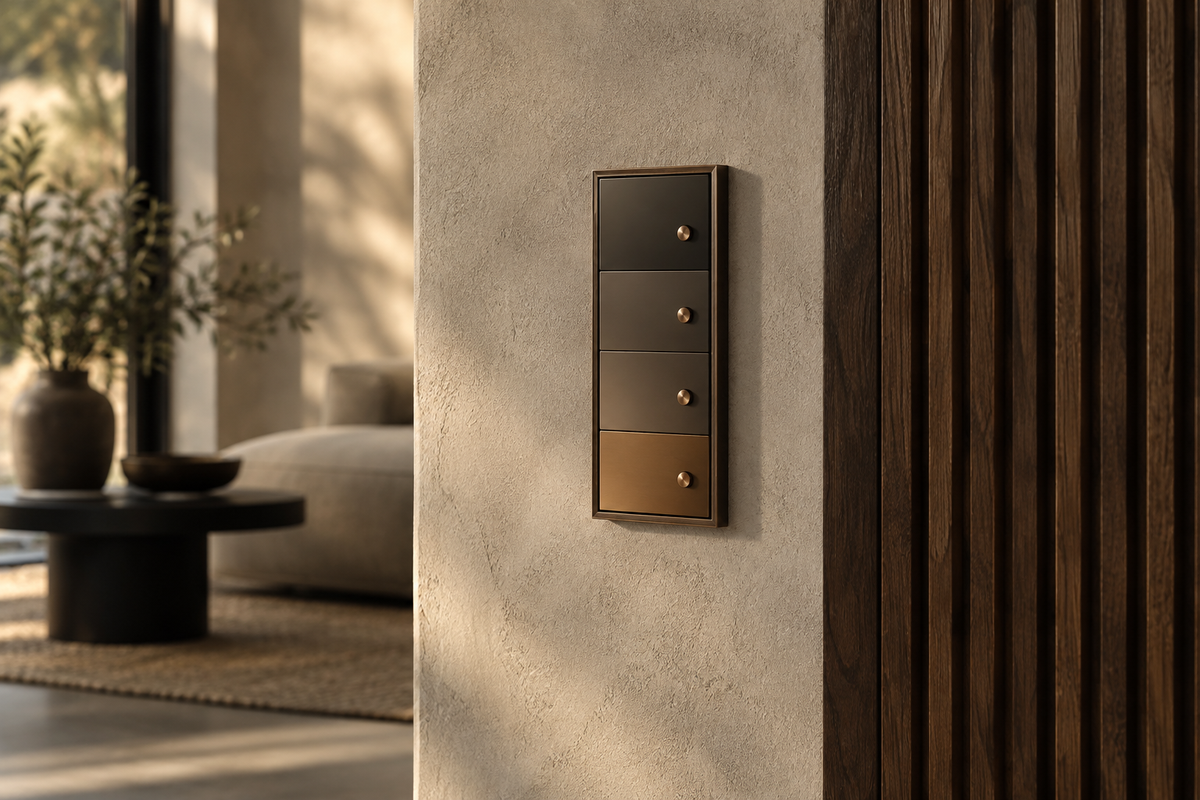
A guest walks into the living room. There are eight buttons on the wall, a touch panel beside them and an app they do not have. They want one thing: the lights.
This is where many technically capable smart homes fail. They expose the complexity of the system instead of absorbing it.
The best interface is not the one with the most functions. It is the one that makes the right action feel obvious.
Begin with moments, not circuits
Electrical documentation naturally describes loads: pendant, downlights, cove, joinery, lamps. People do not experience a room that way. They experience cooking, dining, reading, entertaining and leaving.
Scenes translate technical detail into intent. A single “Dine” action can set several lighting groups to considered levels, lower selected blinds and leave the task lighting elsewhere unchanged. The user makes one decision; the system handles the composition.
Individual control still matters, especially for adjustment and servicing. It simply does not need to dominate the everyday interface.
Give every control a clear hierarchy
A useful wall station usually needs three layers:
- The obvious action: the function someone reaches for first.
- The room scenes: a small number of meaningful alternatives.
- The expert layer: detailed adjustment in an app or touch panel when it is genuinely needed.
Trying to place every capability at the first layer creates a control that looks powerful and feels confusing. Restraint is a feature.
Use the same grammar throughout the home
If the upper-left button means “on” in one room and “blinds up” in the next, the house has no common language.
Choose conventions and repeat them. Keep off or exit actions in a consistent position. Use the same words for the same type of scene. Decide when a short press, long press or double press is appropriate — and avoid hidden gestures for essential functions.
Consistency allows the occupants to stop reading the controls. That is when the system begins to feel natural.
Design for the person without the app
Children, grandparents, cleaners, guests and house-sitters should be able to operate the essential functions without downloading anything.
A simple test is to walk someone unfamiliar with the project into a room and ask them to turn it on, set a comfortable scene and leave. If they hesitate, the interface needs refinement — not another instruction sheet.
Make the hardware belong to the interior
Wall controls are among the most frequently touched objects in a home. They sit at eye level against carefully selected stone, timber, plaster and joinery. Their material and proportion deserve the same consideration as tapware or door hardware.
Premium KNX controls such as the Waltz range allow the visible interface to feel intentional while the KNX system behind it carries out sophisticated scenes and whole-home commands. The point is not decoration for its own sake. It is to make advanced control feel like a natural part of the architecture.
Let automation remove interactions — carefully
The most elegant control is sometimes no control at all. Presence sensing can illuminate a hallway softly at night. A leaving scene can turn off selected loads throughout the home. Shading can respond to heat and glare before the room becomes uncomfortable.
But automation should be predictable, reversible and quiet. If a sensor repeatedly turns lights off while someone is reading, the technology has become the problem. Good commissioning includes thresholds, delays and exceptions that reflect real behaviour.
Five rules for a calmer interface
- Give every room an obvious way to turn on and off.
- Use a small number of scenes named for activities, not equipment.
- Repeat button positions and language throughout the home.
- Keep essential functions available without a phone or internet connection.
- Commission the system after the occupants have lived with it; real routines reveal what drawings cannot.
A sophisticated system should create a simpler experience, not advertise its own complexity.
Quiet technology is the real luxury
A premium smart home does not need to look futuristic. It needs to feel composed. The lights settle into the right scene. The blinds move when they are useful. The wall control is beautiful, tactile and immediately understandable.
That experience comes from combining thoughtful interface design with a flexible control platform — and from commissioning both around people, not just products.
Explore a Waltz KNX wall control or talk to Kadan about designing a calmer control experience.
Share:
Seven Decisions to Make Before Your Smart-Home Cabling Is Locked In
KNX and Matter Explained: What They Do in a Modern Home